Dr. Javier Sanfélix

Dr. Sarah Fischer

Leonard Courapied
Simulation of the homopolymerisation of bismaleimide monomers by tailored reactive Molecular Dynamics

Figure 1. MDAB molecule and its 3D representation.
Table 1. The mechanical properties of three different MDAB polymer systems.

Prof. Irene de Diego Calderón
Collaborative AI Framework to Boost Our Metallurgical Expertise and Accelerate Product Development

Prof. Alejandro Franco
Digital Twin-Based Optimization of Battery Manufacturing Processes

Prof. Marcus Stricker
Materials Informatics: Appreciation of Data and Algorithms

Leonard Courapied

Dr. Irene de Diego Calderón

Prof. Alejandro Franco

Prof. Marcus Stricker

Prof. Dr. Sergio Amancio-Filho

Prof. Dr. MÁrio Ferreira

PROF. Sarah Haigh

Dr. Jürgen TIEDJE 

Prof. Dr. Stefan Pogatscher

Prof. DR. ROSA MENÉNDEZ

Prof. Dr. Franz Faupel

Dr. laura del río fernández

Gloria Rodríguez

Irene García Cano

Ms. Anna Muesmann

Daniel Sola

Teresa Guraya

Paloma Fernández Sánchez

Dept. Física de Materiales, Fac. Ciencias Físicas, Universidad Complutense

Juan José de Damborenea

Anna Zervaki

Rodrigo Moreno

Prof. Dr. Antonio Salinas Sánchez (ES)

Dr. Faith Nightingale (UK)

Prof. Dr. Christof Sommitsch (AU)

Dr.-Ing. Dirk Lehmhus (DE)

Prof. Dr. Sandra Carvalho (PT)

Prof. Dr.-Ing. Thomas Niendorf (DE)

Prof. Dr. Joanna Wojewoda-Budka (PO)

Prof. Dr. Greg Haidemenopoulos (GR)

Prof. Dr. Francesco Baldi (IT)

Prof. Dr. Donatella Giuranno (IT)

Dr. David Mercier (FR)

Dr. David MERCIER completed his PhD in material science and engineering at the University of Grenoble (France) in 2012, specializing in the design of thin films tailored for applications in microelectronics. His journey then led him to enriching experiences through impactful postdoctoral research projects conducted in Germany (MPIE) and Belgium (CRM Group) between 2013 and 2018. During this period, his focus shifted to the realm of metallurgy, where he dedicated his efforts to multiscale modeling and the characterization of mechanical properties using cutting-edge techniques like nanoindentation. Notably, David played an active role in advancing nanoindentation data processing routines, showcasing his contributions on his GitHub page (https://github.com/DavidMercier). In 2018, David joined the UK company Granta Design, where he spearheaded collaborative initiatives with academics on materials education. After the acquisition of Granta Design by Ansys Inc., David transitioned into a pivotal role at the Office of the CTO as a Senior Collaborative R&D Project Manager. He has been at the forefront of leading European-funded projects, focusing on the development of innovative software solutions, particularly in the field of Integrated Computational Materials Engineering (ICME) and Material Informatics.

Prof. Dr. Gesa Beck (DE)

Prof. dr. ir. Annabel Braem (BE)

Prof. Dr. Theodora Kyratsi (CY)

Prof. Dr. Arnaldo Moreno (ES)

Prof. Dr. Francisca G. Caballero (ES)

Prof. Ms. Francisca G. Caballero is Research Professor at the Spanish National Centre for Metals Research (CENIM-CSIC) since 2018. She obtained her Ph.D. in Physics from the Complutense University of Madrid in 1999 for studying solid-solid phase transformations in steels during reheating. From 1997 to 2000, she worked as a research associate at the University of Cambridge in UK on the design of carbide-free bainitic steels. She has held a visiting scientist position at the Oak Ridge National Laboratory in Oak Ridge-TN-USA since 2004. Additionally, between 2013 and 2014 she has been the Deputy Director of Science at CENIM, and Vice-Rector for Postgraduate Studies and Research at Menendez Pelayo International University between 2014 and 2018. From 2018 to 2021 she has worked for Elsevier Inc as Editor-in-Chief of the Encyclopedia of Materials: Metals and Alloys published in 2021. Prof. Caballero’s current research objective is to understand the relationship among the steel processing, its structure and its mechanical properties. In this regard, she investigates the transformation mechanisms, characterize the structure of the material from the micro to the nano-scale describing the physics and chemistry that govern the processes of transformation of steel and its properties under real conditions of use.

Poster sessions

Information for poster authors

An essential part of the EUROMAT conference is the active discussion of researchers and students during the poster session. Therefore, there will be several slots available to allow the discussion and networking between researchers, professors, students and industry leaders during those poster sessions. They provide an unique opportunity not only to present your most recent research activities but also to discuss them with the other participants and to receive in person the last news and recent progress in materials science and technology.

Accordingly, the organization committee of the FEMS EUROMAT 2025 gladly announces the concession of 2 awards in each of the 2 sessions of poster to be held during the conference. The winners will be announced at the closing ceremony.

Important information for all poster authors


Poster sessions will take place in 2 sessions:


POSTER SESSION 1

Monday, September 15

13:15-14:30 & 16:30-17:00

Tuesday, September 16

13:00-14:30 & 16:30-17:00

Posters of Session 1 must be hung by 12:00 AM of Monday and taken down before 18:00 of Tuesday.


POSTER SESSION 2

Wednesday, September 17

13:00-14:30 & 16:30-17:00

Thursday, September 18

13:00-14:30 & 16:30-17:00

Posters of Session 2 must be hung by 12:00 AM of Wednesday and taken down before 18:00 of Thursday.


For your poster please, use the official template attached.

There will be panels to hang the posters. Each panel will have a stick with the symposium and paper number to locate the corresponding poster.

Poster not retired at the end of the session will be destroyed.

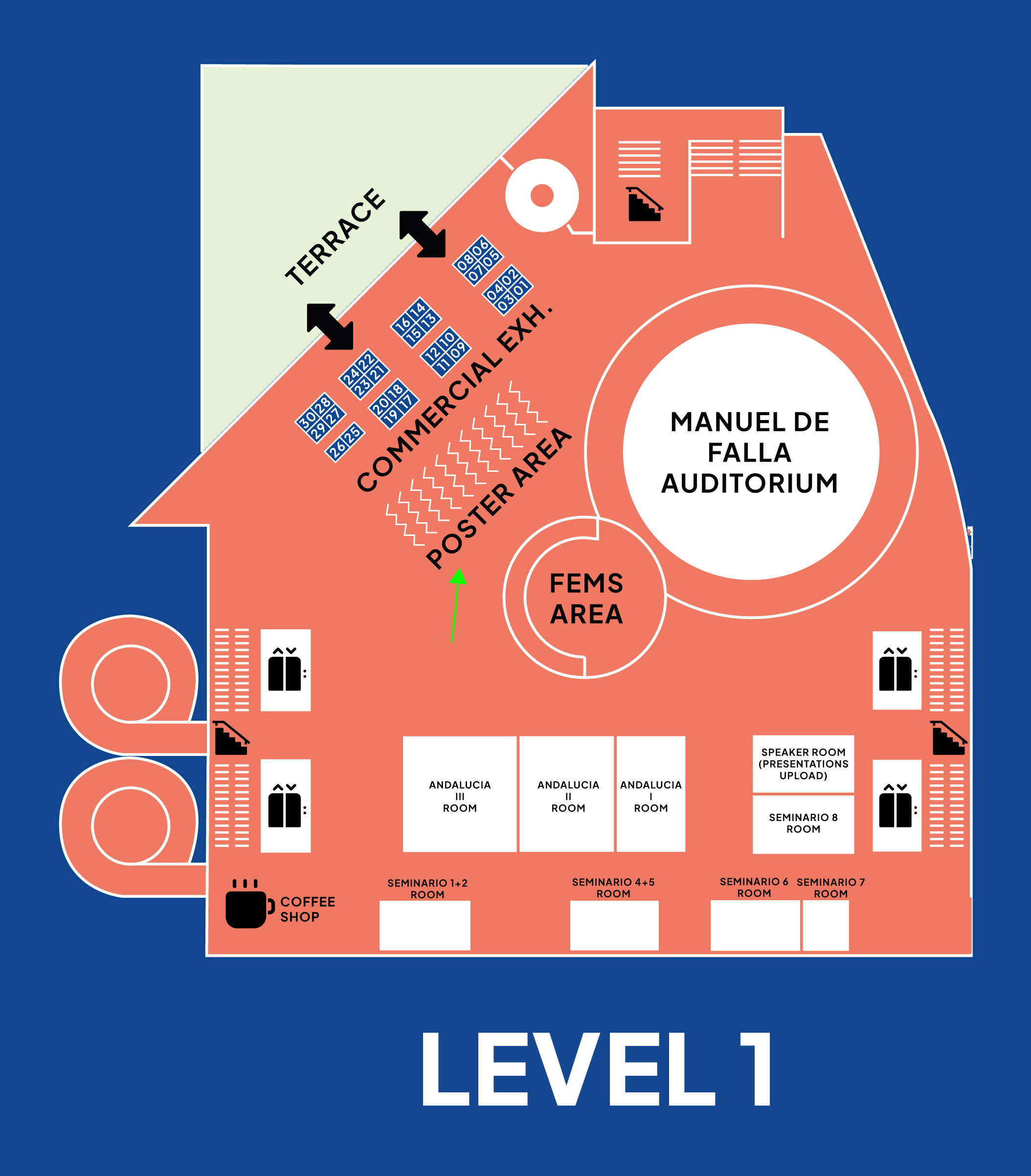
The poster has to be hanged in LEVEL 1 Poster area.

The two best posters presented across the two poster sessions will be awarded.

All works accepted as posters at the Congress are eligible.

Special consideration will be given to the formal structure of the poster (writing, syntax, organization, visual impact) and the topic (originality of the study, etc.).